
Chola Bronze Casting · Murugan's Foundry · Swamimalai, Kumbakonam
The Process That Has Not Changed in 1,000 Years
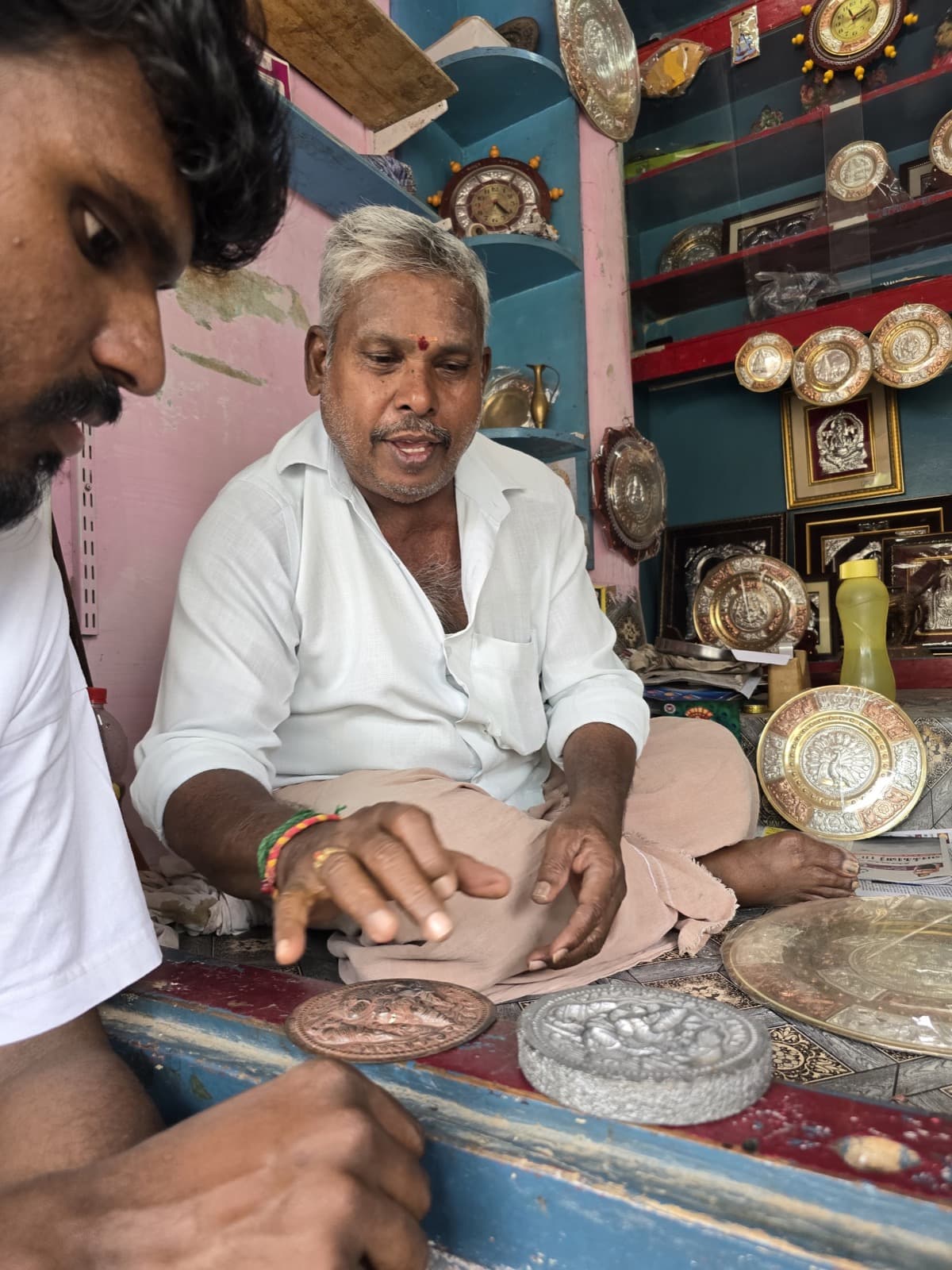
The idols in the Smithsonian and the Met were made here. In this foundry. By this family.
Location
Swamimalai
Duration
1–1.5 hours
Host
Murugan
Price
₹2,000–2,500 per person
The hook
The Nataraja at the Smithsonian. The Parvati at the Metropolitan Museum of Art in New York. The giant Nataraja gifted by India to CERN in Geneva. All cast in Swamimalai, using the same lost-wax method, in the same alloy of five metals — panchaloka — that Chola artisans used a thousand years ago. Murugan’s foundry is 6 kilometres from Kumbakonam. The temperature when the metal is poured is 1,500 degrees Celsius. Every piece is a single cast. No two are identical.
Hosted by locals
Murugan. 31 years with fire and bronze.
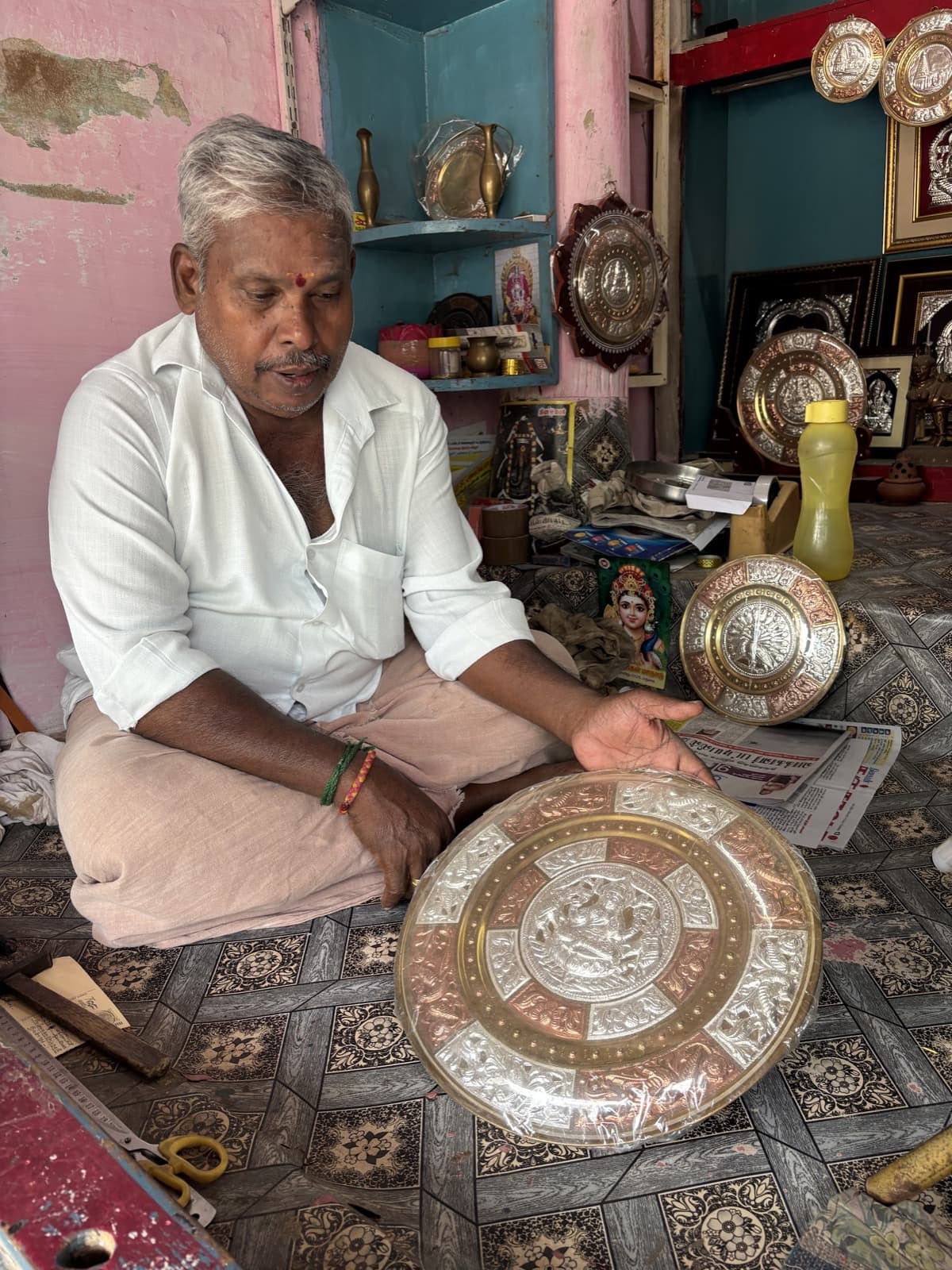
He is a Sthapathi — a master sculptor trained in Shilpa Shastra, the ancient text that governs the proportions, gestures, and spiritual measurements of every deity. He does not work from photographs or his own imagination. He works from a system of measurements that has been handed down for a thousand years, calculated using strips of coconut leaf folded to specific ratios of the idol’s total height. Every finger, every ankle, every eye is a precise fraction of the whole.
What you will do
A real experience, not a performance.
Storytelling. The history, the meaning, the why.
Hands-on. How much you do, not just watch.
Hospitality. Warmth, tea, time with the host.
- 01
You arrive at the foundry to the smell of beeswax and clay. Murugan shows you the current commission — perhaps a Ganesha for a temple, perhaps a Shiva Nataraja mid-dance. He shows you the wax model first: the original sculpture, in beeswax, from which everything else follows. He explains the Shilpa Shastra measurements using the coconut leaf strips — how the hand-span of the intended deity determines the length of every other element. You understand that you are not looking at art. You are looking at a precise cosmological document.
- 02
He walks you through the lost-wax process: the wax model encased in layers of Cauvery riverbed clay, dried slowly, fired to drain the wax, then filled with molten panchaloka — five metals, five cosmic elements. The mould is broken. The idol emerges. He shows you a recently completed piece before the final chiseling and polishing. You hold it. It is heavier than you imagined. He tells you where it is going. The temple it will be installed in. The ritual its first bathing will require.
Good to know
The honest details, before you come.
Duration
1 to 1.5 hours. This experience needs time. Do not rush it.
Group size
Maximum 4. The foundry is a working space and safety requires managed numbers.
Children
Minimum age 12. The foundry environment involves fire and molten metal. Not suitable for young children.
What to wear
Closed-toe shoes mandatory. The foundry floor has metal fragments. Light, heat-tolerant clothing.
What you take home
A small fragment of the clay mould from a recently completed casting — the actual earth that held the metal. With a card explaining which deity it was.
GI status
Swamimalai Bronze Icons carry a Geographical Indication tag protecting the authenticity of the lost-wax process and panchaloha composition.
Note
Chola bronzes from Swamimalai are held in the Smithsonian, the Metropolitan Museum of Art, and major museums in Europe. The foundry you are visiting is part of this living tradition.
No payment now
Request a private or shared session.
Spend an afternoon with Murugan. ₹2,000–2,500 per person · 1–1.5 hours · up to 4 guests. Our team will confirm availability with you on WhatsApp.
Cancellation terms vary by host and experience. Review the applicable policy before payment.
What stays with you
One mould, one piece. We cannot make two the same. The Cholas understood this. We have not changed the method. There is no reason to.
Murugan
Explore next
Sirumugai Silk Weaving
More in Thanjavur