
Craft guide
Kanchipuram vs Thirubhuvanam silk: how the two sarees differ
By Oorva · Published
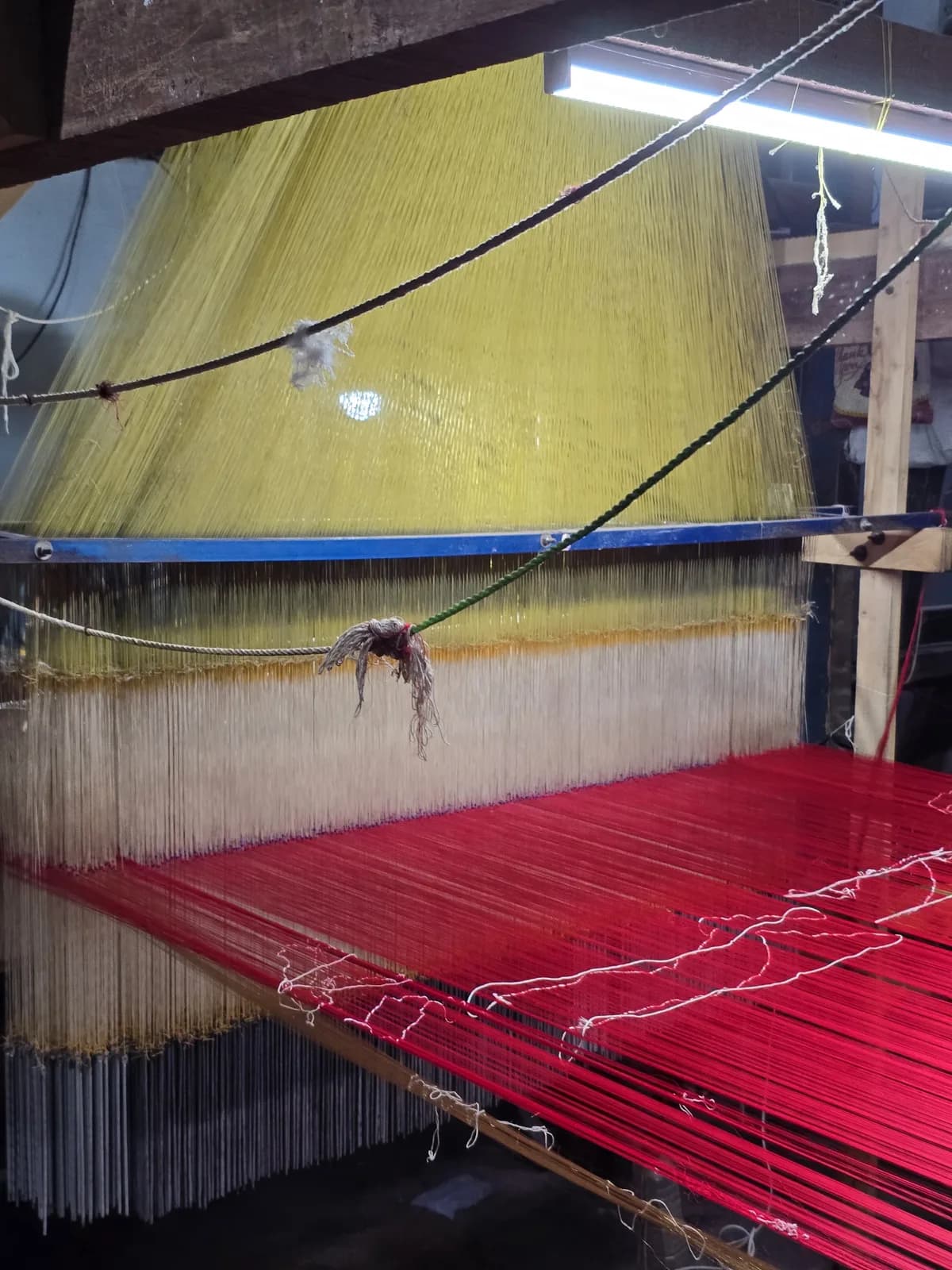
Kanchipuram and Thirubhuvanam are two of Tamil Nadu's GI-tagged silk saree towns. Both weave mulberry silk with zari on handlooms. The short version: a Kanchipuram saree is defined by its korvai border, woven separately and interlocked with the body, and got its GI tag in 2005. A Thirubhuvanam saree, from a weaving town near Kumbakonam, is known for its continuous pallu and long-lasting zari, and got its GI tag in 2019.
You can watch both being woven with Oorva: the Kanchipuram silk weaving visit and the Thirubhuvanam silk weaving visit.
At a glance
| Kanchipuram | Thirubhuvanam | |
|---|---|---|
| Where | Kanchipuram town, 72 km south-west of Chennai | Thirubhuvanam, Thanjavur district, on the Kumbakonam to Mayiladuthurai road |
| Silk | Mulberry silk | Mulberry silk |
| Signature technique | Korvai: body and contrast border woven separately and interlocked; pallu joined by petni | Pallu woven continuously on the loom; THICO sarees carry a gopuram symbol on the border |
| Zari | Made from silver and gold | Heavy, long-lasting zari; it makes up most of the weight above the silk |
| Weight | No authoritative figure found; known as a heavy silk | About 450 to 1,250 g, of which the silk is about 400 g |
| GI tag | Registered 2005 (certificate 6, 2 June 2005) | Registered 2019 (certificate 342, 11 March 2019) |
Where each silk comes from
Kanchipuram is a temple town on the Vegavathi river, 72 km south-west of Chennai. The usual account traces its silk trade to Raja Raja Chola I inviting weavers from Saurashtra and Gujarat to settle there, with more weavers arriving from Andhra Pradesh under Vijayanagara rule in the 15th century. As of 2008 an estimated 5,000 families worked in saree production in the town. See the Kanchipuram silk weaving experience.
Thirubhuvanam is a weaving town in Thanjavur district, on the road from Kumbakonam to Mayiladuthurai. Deccan Chronicle's report on the GI tag says silk sarees have been woven there since the time of Kulothunga Chola III. DT Next adds that weavers of the Saurashtra community settled in Thirubhuvanam at the request of the Nayak and Serfoji kings, and that more than 1,500 families in the Thirubhuvanam and Kumbakonam area still weave. See the Thirubhuvanam silk weaving experience.
The weave: korvai and the continuous pallu
A Kanchipuram saree's contrast border is made with the korvai technique. The body and border are woven separately and interlocked, and the joint is said to be strong enough that the border will not come away even if the saree tears. Three shuttles are used, and the pallu is joined to the body with a weave called petni, which a skilled weaver makes look like one continuous piece. Watch a Kanchipuram saree on the loom.
In a Thirubhuvanam saree, according to the GI coverage, the pallu is woven continuously on the loom, so it flows on from the body. Sarees from the Thirubuvanam Silk Handloom Weavers Co-operative (THICO) carry a gopuram, a temple tower, on the border, and wedding collections feature temple designs across the pallu. An elaborate saree takes a weaver almost 15 days. Watch a Thirubhuvanam saree on the loom.
Silk, zari and weight
Both are woven from mulberry silk. For Kanchipuram, Dastkari Haat Samiti notes that the silk is bought in from Karnataka and that the zari, the metallic thread of the borders and pallu, is made from silver and gold.
For Thirubhuvanam, Deccan Chronicle gives a weight of about 450 to 1,250 g per saree, of which the silk alone is about 400 g; the rest is zari. DT Next describes the sarees as known for their long-lasting zari. We found no authoritative weight figure for a Kanchipuram saree, so we do not give one here. For both, the amount of zari is what makes one saree much heavier than another.
GI tags
"Kancheepuram Silk" is application 15 in the Indian Geographical Indications Registry, filed on 7 October 2004 by the Tamil Nadu Department of Handlooms and Textiles. It was registered with certificate 6, dated 2 June 2005, one of the earliest GI registrations in India.
"Thirubuvanam Silk Sarees" is application 480, filed on 15 April 2014 by the Thirubuvanam Silk Handloom Weavers Co-operative Production and Sale Society. It was registered with certificate 342, dated 11 March 2019. THICO itself was formed in 1955.
Price
Both are handwoven silk sarees with zari, and neither has a single price. The cost of a saree varies widely with the intricacy of the work, the colours, the pattern and the materials, and the zari adds to the weight. We do not quote figures, because they depend on the saree and change over time.
Where to watch them woven
Oorva's Thirubhuvanam silk weaving visit takes you into a weaver's home in Thirubhuvanam, hosted by Sudarsan Anna, for 1 to 1.5 hours, with at most 4 guests. You watch a silk saree come together on the handloom and look closely at the threads, the motifs and the zari. It costs ₹650 per person.
The Kanchipuram silk weaving experience takes you into a weaver's home in Kanchipuram town to watch a saree being woven. Oorva opens in Kancheepuram district next, so it is not bookable yet: ask on the page and we will tell you when dates are ready.
Questions
- Which is better, Kanchipuram or Thirubhuvanam silk?
- Neither is better in general. Both are handwoven from mulberry silk with zari and both carry a GI tag. Kanchipuram is known for its korvai contrast borders; Thirubhuvanam for its continuous pallu and long-lasting zari. Choose by the saree in front of you: its zari, its weave and how it drapes on you.
- When did Thirubhuvanam silk get its GI tag?
- The Thirubuvanam Silk Handloom Weavers Co-operative filed the application on 15 April 2014. The registry issued certificate 342, dated 11 March 2019.
- When did Kanchipuram silk get its GI tag?
- The Tamil Nadu Department of Handlooms and Textiles filed the application on 7 October 2004. "Kancheepuram Silk" was registered with certificate 6, dated 2 June 2005.
- What is korvai in a Kanchipuram saree?
- Korvai is the technique that gives a Kanchipuram saree its contrast border. The body and border are woven separately and interlocked on the loom, so firmly that the border is said to hold even if the saree tears.
Sources
- Intellectual Property India, Geographical Indications Registry: application 15, "Kancheepuram Silk"
- Intellectual Property India, Geographical Indications Registry: application 480, "Thirubuvanam Silk Sarees"
- Dastkari Haat Samiti, "Kanjivaram Sari", Google Arts & Culture
- Wikipedia, "Kanchipuram silk sari"
- Wikipedia, "Kanchipuram"
- Deccan Chronicle, "Thirubuvanam silk saree gets GI tag", G. Srinivasan and A. Arul Palani, 13 March 2019
- DT Next, "Chola-era Thirubuvanam sarees awarded GI tag", 12 March 2019
- Wikipedia, "Thirubuvanam Silk Sarees"