
Craft guide
What is Karuppur Kalamkari?
By Oorva · Published
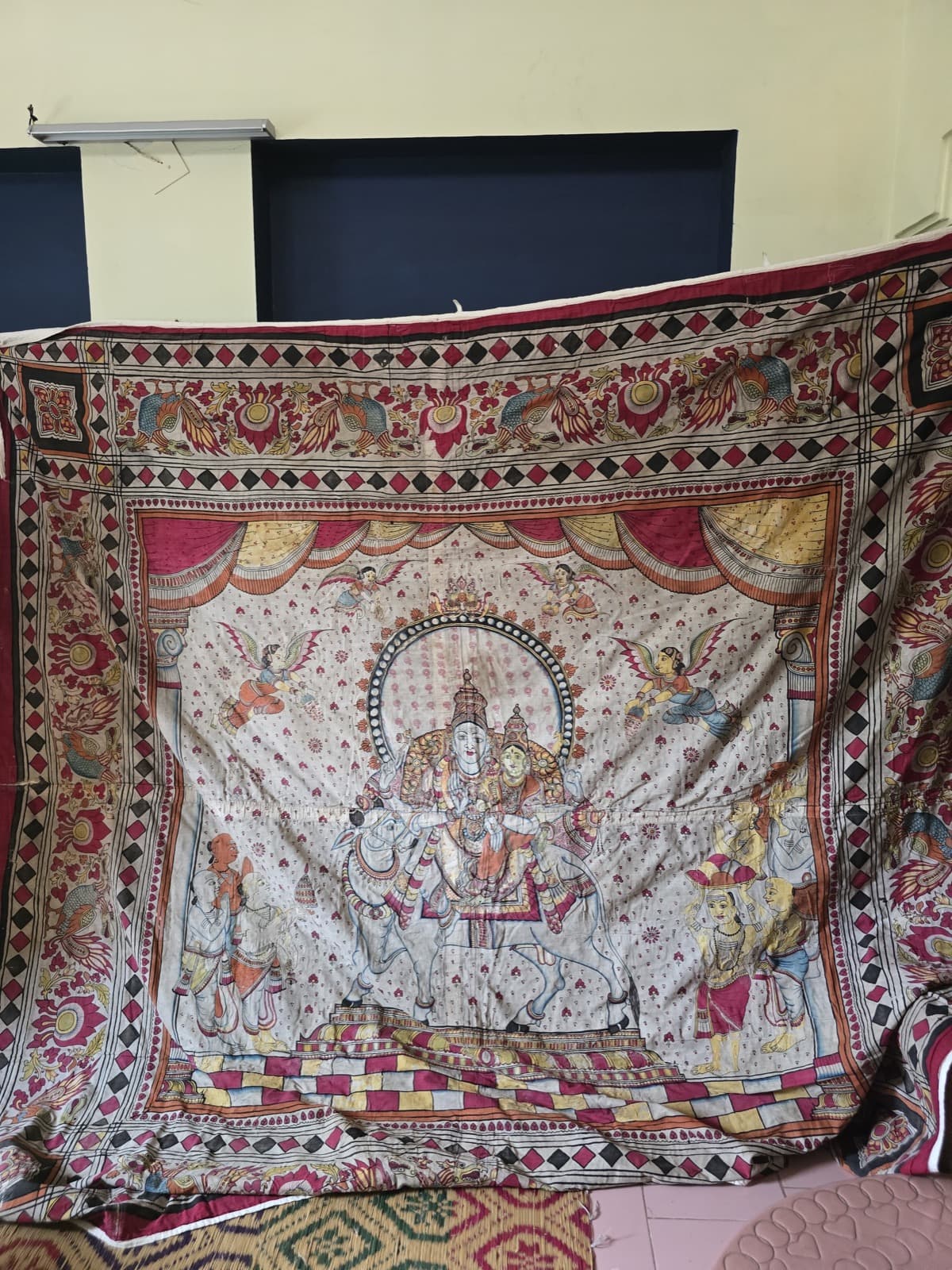
Karuppur Kalamkari is a Tamil Nadu tradition of painting cloth by hand with natural dyes. Its pieces were made mainly for temples: canopies, ceiling cloths, umbrella covers, cylindrical hangings called thombai and covers for temple chariots. It is named after Karuppur, a village in Ariyalur district, and is also practised around Sikkalnayakkanpettai and Thiruppanandal in Thanjavur district. You will also see it spelt Karrupur. Since 2021 "Karuppur Kalamkari Paintings" has been a registered Geographical Indication.
To see it painted, and to paint a piece yourself, Oorva hosts a Karuppur Kalamkari painting visit at an artisan's home in Sikkalnayakkanpettai.
What the name means
Kalamkari comes from Persian: kalam means pen and kari means craftsmanship. The kalam is the artist's pen, a stick of bamboo, date palm or tamarind twig used to draw outlines and apply colour. Karuppur Kalamkari is also known as chithra paddam, figurative drawing.
Where Karuppur Kalamkari is made
The Hindu's report on the GI tag places the craft at Karuppur in Udayarpalayam taluk of Ariyalur district, and in villages around Sikkalnayakkanpettai and Thiruppanandal in Thanjavur district. It says artisans from Sikkalnayakkanpettai, near Kumbakonam, have practised it for many generations.
It is a small craft. The 2024 study in the Indian Journal of Traditional Knowledge (IJTK) worked with an artisan family in Sikkalnayakkanpettai, and Forbes India's 2023 profile describes a workshop there with a team of 15 artists.
A short history
The IJTK study says Karuppur Kalamkari artisans were invited by the Thanjavur court in the seventeenth or early eighteenth century to make clothing for the kings and to paint stories on cloth used to decorate temples. It also records a tradition that Sevappa Nayak, the first Nayak ruler of Thanjavur, brought 25 families of Srikalahasti kalamkari artists to work in Thanjavur's palace and temples, and that this is how the Karuppur style branched off from Srikalahasti. Forbes India says the paintings were popular on the clothing of the nobility in the Maratha period.
Temples kept the craft going. According to the IJTK study, zamindars and heads of religious mutts used the painted cloths to decorate temples, and the artisans had the right to decorate 27 temples, each of which needed three sets of temple car decorations. Pieces are still used in temples and mutts, for example during festivals such as Panguni Uthiram.
Sources give much older dates for the craft, but none we could check supports them, so we do not repeat them here.
What it looks like
Common motifs are the yazhi (a mythical lion-like creature), peacocks, swans, flowers and images of deities, along with the screw pine flower (thazhampoo). The palette was traditionally black, red and yellow; a pale blue has been added in recent years. Newer work includes sarees, framed screens and wall hangings alongside temple pieces.
How Karuppur Kalamkari is made
The IJTK study, based on work with an artisan family in Sikkalnayakkanpettai, describes these steps:
- Cotton (gada) cloth is washed in plain water to remove its starch and dried.
- It is soaked in buffalo milk and boiled rice water (1 part milk to 3 parts rice water), which smooths the cloth and stops the black outline from spreading, then washed in a pond or running water.
- It is treated with myrobalan (kadukkai) solution and dried in the sun for 6 to 8 hours.
- The design is sketched, then outlined with a tamarind-twig pen dipped in kasimkaram, a black made from jaggery, water and iron filings left in a mud pot for about 20 days. The cloth is washed and dried.
- Colours are filled in one at a time, darkest first, each dye mixed with a natural mordant (myrobalan and cow dung). After each colour the cloth is dried, washed, soaked in milk and dried again, so the next colour does not run.
- The finished cloth is soaked in a mix of buffalo milk, rice water, adhatoda leaf and gum, washed in running water to carry off excess dye, and dried in the shade.
Red comes from the bark or roots of madder, yellow from boiled pomegranate peel and blue from natural indigo; green is yellow and blue mixed. Forbes India counts 23 steps in all, with repeated rounds of dyeing, starching, washing and drying.
Karuppur vs Srikalahasti and Machilipatnam kalamkari
The two best-known kalamkari traditions are in Andhra Pradesh. Srikalahasti kalamkari is drawn freehand with a kalam and filled in by hand, mostly with Hindu myths and epic stories. Machilipatnam kalamkari is printed with carved wooden blocks. Karuppur is the Tamil Nadu style: hand-painted like Srikalahasti, from which the IJTK study says it branched off, and made above all for the temples of the Thanjavur region. "Unlike others, we do not use screen printing or block printing," a Karuppur artisan told Forbes India.
| Karuppur | Srikalahasti | Machilipatnam | |
|---|---|---|---|
| Where | Karuppur (Ariyalur district) and villages around Sikkalnayakkanpettai and Thiruppanandal (Thanjavur district) | Srikalahasti, near Tirupati, Andhra Pradesh | Machilipatnam and Pedana, Krishna district, Andhra Pradesh |
| How the design goes on | Drawn and painted by hand; no block or screen printing | Drawn freehand with a kalam (pen) and filled in by hand | Printed with carved wooden blocks |
| Typical subjects | Deities, yazhi, peacocks, swans, flowers; temple hangings and chariot cloths | Hindu myths and epic stories; temple cloths | Persian-influenced motifs such as creepers and lotus |
Not to be confused with Kodali Karuppur
Kodali Karuppur is a different textile with a similar name. The IJTK study describes it as fine cotton muslin woven with gold and silver zari, combining wax-resist painting, block printing and weaving. Jagada Rajappa's encyclopedia entry on Karuppur textiles describes this kind of resist-dyed, gold-brocaded cloth, drawn with a kalam and made for the royal court of Thanjavur; saris, dhotis and turbans survive in museum collections, and the saris were still being made in 1855. A GI application for "Kodali Karuppur Saree" (application 409) was filed in 2013 and later withdrawn. Karuppur Kalamkari, the painted temple cloth, is the one with the GI tag.
The GI tag
"Karuppur Kalamkari Paintings" is application 424 in the Indian Geographical Indications Registry, a handicraft in class 24. The Tamil Nadu Handicrafts Development Corporation (Poompuhar) filed it on 28 May 2013. It was registered with certificate 373, dated 14 September 2021, and the registration is valid until 27 May 2033.
Paint a piece yourself in Thanjavur district
Oorva's Kalamkari painting experience takes you into a Karuppur Kalamkari artisan's home in Sikkalnayakkanpettai, Thanjavur district, hosted by Raj Mohan Anna, for 1.5 to 2 hours, with at most 4 guests. You hear the history of the craft, look closely at the motifs, the traditional techniques and the natural elements behind it, and watch him draw and paint. Then you paint your own Kalamkari piece with him guiding you, and take it home. The visit is in Tamil and English. It costs ₹1,200 per person.
Questions
- Where is Karuppur Kalamkari made?
- In Karuppur and nearby villages in Udayarpalayam taluk of Ariyalur district, and in villages around Sikkalnayakkanpettai and Thiruppanandal in Thanjavur district, Tamil Nadu.
- Does Karuppur Kalamkari have a GI tag?
- Yes. "Karuppur Kalamkari Paintings" is application 424 in the Indian Geographical Indications Registry, filed on 28 May 2013 by the Tamil Nadu Handicrafts Development Corporation (Poompuhar). It was registered with certificate 373, dated 14 September 2021.
- How is Karuppur Kalamkari different from Srikalahasti and Machilipatnam kalamkari?
- Machilipatnam kalamkari is block-printed. Srikalahasti and Karuppur are both drawn and painted by hand, and the IJTK study describes Karuppur as a style that branched off from Srikalahasti. Karuppur artisans say they use no block or screen printing at all. Karuppur pieces were made mainly for temples in the Thanjavur region.
- What dyes are used in Karuppur Kalamkari?
- Natural ones. Black, called kasimkaram, is made from jaggery, water and iron filings left to stand for about 20 days. Red comes from madder, yellow from boiled pomegranate peel and blue from indigo. Myrobalan (kadukkai) and cow dung act as mordants. The palette was traditionally black, red and yellow, with a pale blue added in recent years.
- Can I try Karuppur Kalamkari painting myself?
- Yes. Oorva hosts a small-group visit to a Karuppur Kalamkari artisan’s home in Sikkalnayakkanpettai, Thanjavur district, where you watch him draw and paint and then paint your own piece to take home.
Sources
- Intellectual Property India, Geographical Indications Registry: application 424, "Karuppur Kalamkari Paintings"
- Intellectual Property India, Geographical Indications Registry: application 409, "Kodali Karuppur Saree"
- P. Pavithra, T. Raagavi, G. R. Ramya Gayathri, R. Sabitha, R. Srividya, U. Thakreem Banu and Banumathy S., "Study on Indian traditional art: Karuppur Kalamkari", Indian Journal of Traditional Knowledge 23(7), July 2024, pp 702-709
- GKToday, "GI Tag for Karuppur kalamkari paintings, Kallakurichi wood carvings", 12 October 2021, reporting The Hindu
- Forbes India, "How the intricate motifs of Karuppur Kalamkari paintings transcend time, connecting us to shared human history", Veidehi Gite, 7 October 2023
- Jagada Rajappa, "Textiles: Karuppur", Encyclopedia of India, via Encyclopedia.com
- Wikipedia, "Kalamkari"
- Wikipedia, "Srikalahasti kalamkari"