
Craft guide
What is a Thanjavur doll? (Thalaiyatti Bommai)
By Oorva · Published
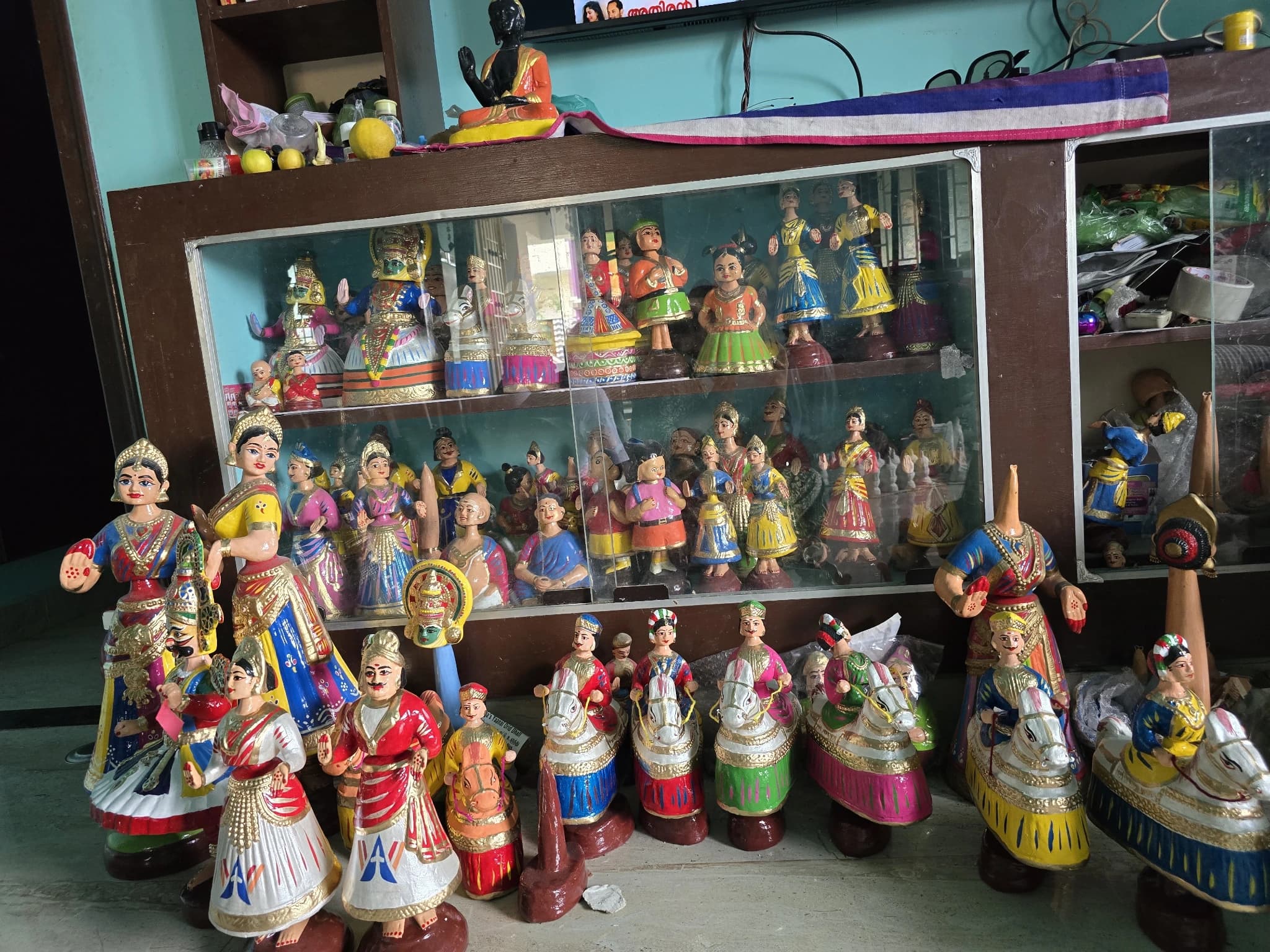
A Thanjavur doll is a hand-painted roly-poly toy from Thanjavur in Tamil Nadu. Its weight sits at the very bottom of a rounded base, so when you tap it, it rocks in slow swings and comes back upright instead of falling over. In Tamil it is called thalaiyatti bommai (also written thalai aati bommai), the nodding doll. Since 2008 "Thanjavur Doll" has been a registered Geographical Indication.
If you want to see one made rather than read about it, Oorva hosts a Thanjavur doll making visit in a working workshop in Thanjavur.
Two dolls, one name
Two kinds of doll go by the Thanjavur name. The older one is the Raja-Rani couple, also called the Chettiyar dolls: a king and a queen, each on a round base, that rock from side to side. The Thanjavur Chamber of Commerce's GI application describes the dolls as historically made in pairs, a Raja and a Rani.
The second is the dancing doll, a dancing lady whose head and body keep moving after a single touch. A doll business owner interviewed by Covai Post describes her as the later, more modern design, and says iron strands are used to shape the swaying, nodding head.
The names overlap in practice. Some writers call the Raja-Rani pair the dancing dolls of Thanjavur, and some call only the dancing lady thalaiyatti bommai. Both work on the same principle.
Why a Thanjavur doll never falls down
The trick is where the weight sits. The doll's centre of gravity and almost all of its mass are at its lowest point, inside a curved base. A clay piece placed inside that round pedestal keeps the doll upright. Push it, and gravity pulls the heavy base back under the light body, which gives the slow, dance-like oscillation the dolls are known for.
What Thanjavur dolls are made of
The GI application lists plaster of Paris, wood pulp and clay taken from the banks of the Cauvery, the river Thanjavur sits on. Makers describe the mix in more detail. The Raja-Rani dolls are made of clay dough. The dancing dolls use a cooked dough of papier mâché, plaster of Paris and tapioca starch.
How a Thanjavur doll is made
NIFT Chennai's documentation of the craft describes these steps:
- Plaster of Paris and paper pulp are mixed with tuber gum into a dough.
- The dough is pressed into moulds to make the front and back panels of the doll.
- Once dry, the panels come out of the mould and paper is applied over them.
- Tuber gum seals the hollow front and back together, and seals the seam to the clay-filled base.
- Each part is smoothed with sandpaper.
- The doll is painted by hand in bright colours; the NIFT account names oil paints.
The GI application notes that women are generally the ones who make the dolls.
The GI tag
"Thanjavur Doll" is GI application 96 in the Indian Geographical Indications Registry, a handicraft in class 28. The Thanjavur Chamber of Commerce filed it on 18 May 2007. The registry shows certificate number 89, dated 9 September 2008, with the registration valid until 17 May 2027 and a list of registered authorised users.
The tag ties the name to Thanjavur district and its makers. A doll sold as a Thanjavur doll is meant to come from there, which guards the craft against copies and poor-quality imitations.
A short history
The usual account is that the dolls came to Thanjavur during the reign of King Serfoji in the early 19th century. The Chamber of Commerce's GI application claims a longer past, saying dolls were already made in Thanjavur before the Nayak period of the 16th century. The sources disagree, so treat both dates as claims rather than settled fact.
Where to see one made in Thanjavur
Oorva's Thanjavur doll making experience takes you into a working doll workshop in Thanjavur, hosted by Balu Anna and Boopathy Anna, for 1 to 1.5 hours, with at most 10 guests. You watch a doll being assembled, hold the weighted base, and see both the Raja-Rani doll and the dancing doll. Then you paint a doll in your own colours and take it home. It costs ₹1,200 per person.
It pairs well with the other crafts around the city. See things to do in Thanjavur for silk weaving, Kalamkari and farm walks hosted by locals.
Questions
- What does thalaiyatti bommai mean?
- It is the Tamil name for the Thanjavur doll, often written thalai aati bommai. It translates as nodding doll or head-shaking doll, after the way the head keeps moving once you tap it.
- Why does a Thanjavur doll never fall over?
- Its weight sits at the very bottom of a round base. A clay piece inside the curved pedestal pulls it back upright every time, so it rocks and settles instead of toppling.
- Does the Thanjavur doll have a GI tag?
- Yes. "Thanjavur Doll" is registered as a Geographical Indication for handicrafts, with certificate number 89 dated 9 September 2008. The applicant was the Thanjavur Chamber of Commerce.
- Can I watch a Thanjavur doll being made?
- Yes. Oorva hosts a small-group visit to a working doll workshop in Thanjavur, where you watch a doll being assembled, paint one in your own colours and take it home.
Sources
- Intellectual Property India, Geographical Indications Registry: application 96, "Thanjavur Doll"
- Thanjavur Chamber of Commerce, GI application (Form GI-1) for Thanjavur dolls, copy hosted by oriGIn
- Wikipedia, "Thanjavur doll"
- Covai Post, "Thanjavur dolls: Coveted heirlooms", Umaima Shafiq, 9 October 2019
- SpicyIP, "SpicyIP Tidbit: A G.I for the Dolls", 13 January 2009
- Tamil Nadu Crafts (NIFT Chennai craft documentation), "The bobblehead bommais of Thanjavur", February 2017